











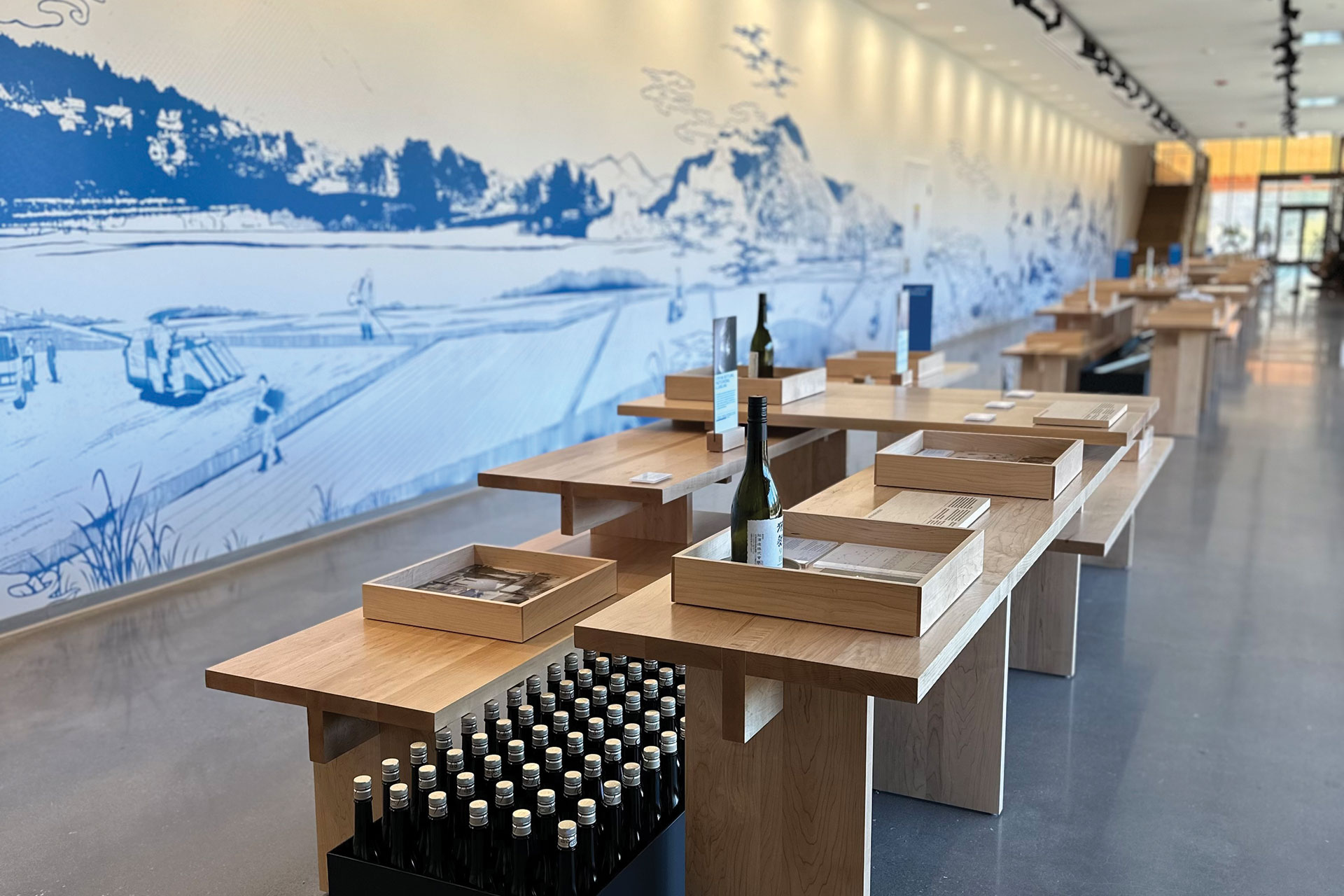
In Hyde Park, Dassai Blue applies centuries-old Japanese brewing techniques to elevate The drink beyond the sushi bar.
By Anthony Giglio
When you pull off Route 9 in Hyde Park, NY—home to the Culinary Institute of America and Franklin Delano Roosevelt’s historic estate—you probably aren’t expecting to walk into one of the most advanced sake breweries in the world. But behind the glass doors of what used to be a Stop & Shop is Dassai Blue, the American outpost of one of Japan’s most revered sake producers, Asahi Shuzo.
Dassai’s US facility, which opened to visitors in the fall of 2023, is a sleek, state-of-the-art production site and tasting room that blends centuries-old Japanese brewing techniques with a distinctly modern sensibility. “People walk in and say, ‘I used to shop here,’” says Jocelyn Heyward, Director of Marketing for Dassai Blue. “Now they come in and get a tour, sip a flight of beautifully crafted sake in wine glasses and leave with an entirely new understanding of what sake can be.”
Dassai has long been known in Japan for innovation. Under the leadership of Hiroshi Sakurai, a fourth-generation sake maker, the company helped usher in a renaissance of ultra-premium sake. Sakurai’s bold move to produce sake year-round (rather than just in winter), and his obsession with rice polishing—sometimes down to a mere 23 percent of the grain remaining—helped redefine what sake could be.
The Hudson Valley location is Dassai’s first outside Japan. The name Dassai Blue comes from a Japanese proverb: “The indigo dye is bluer than the indigo plant.” It suggests that a student can surpass the master—a bold ambition that Dassai Blue embraces as it takes on the US market.
So, what exactly is sake? Despite common misconceptions, sake is not a rice wine—or at least, not in the way we categorize wine or beer. It’s brewed like beer (with a fermentation process), but its aromatic complexity and structure make it more akin to wine. Dassai serves its sake in wine glasses to accentuate its aromatics and showcase its refined texture—or, as we sommeliers say, ‘mouthfeel,’ referring to the tactile sensation a wine (or any beverage) creates on the palate—essentially, how it feels in your mouth, not how it tastes.
True sake is made with just four ingredients: rice, water, koji mold and yeast. Koji, it’s worth mentioning, is a type of friendly fungus that’s used to help ferment foods and drinks, especially in Japanese cuisine. Koji breaks down starches in rice (or other grains) into sugars, which yeast can then turn into alcohol during fermentation. It’s what makes sake possible—and it’s also used to make soy sauce, miso and mirin. Dassai’s Hudson Valley site even includes a dedicated rice polishing facility, where the team mills both imported and Arkansas-grown Yamada-Nishiki rice—a prized variety considered the “King of Sake Rice.” About 80 percent of the rice used in Hyde Park comes from the US, a testament to the brand’s commitment to local agriculture.
A guiding concept in Dassai’s process is tema, a Japanese term that loosely translates to “time, care and human touch.” Every step—from hand-washing the rice in cold water to delicately sprinkling koji over steamed grains—is carried out with patience and precision. “To polish rice down to 20 percent takes more than 100 hours,” Heyward says. “It’s a time-heavy process, and it has to be done with intention and attention to detail. That’s tema.”
Visitors can witness the tema process on guided tours through glass-walled rooms, where steaming rice, koji rooms and fermentation tanks bubble with life. There’s even a chance to sample moromi, the halfway-fermented mash that becomes sake.
Please know that Dassai Blue isn’t just for sake geeks. It’s also a hospitality experience that encourages new drinkers to rethink everything they’ve assumed about the beverage. On any given afternoon, you can sit at the sleek tasting bar, order a sake flight and snack on sushi from a Japanese-trained chef or a cheese plate sourced from Red Hook’s Corner Counter. The brewery also collaborates with the Culinary Institute of America and local bars such as {pretty to think so} in Rhinebeck, NY, which mixes Dassai into cocktails and pours it by the glass.
“We want people to stop thinking about sake as just something you shoot at a hibachi restaurant,” says Heyward. “It’s elegant, it’s expressive—and it pairs beautifully with all kinds of cuisine.”
With ambitions to expand sake’s reach in the US, Dassai Blue hopes to change the conversation—one tasting at a time. “Our chairman always says: ‘Sake isn’t a drink meant to get you drunk—it’s a drink meant to be enjoyed,’” Heyward says. “It’s about refinement, balance and appreciation.”
With Dassai Blue, where locals used to pull off Route 9 to grab groceries, they now come to explore the delicate craft of sake. It’s a transformation from Stop & Shop to stop and sip—and for anyone curious about what Japan’s most refined sake tastes like, it’s well worth pulling over for.
Sake 101: What’s In The Glass?
• Sake is brewed like beer, fermented with koji mold and enjoyed like fine wine
• Junmai Daiginjo is the highest sake category, made only with rice, water, yeast and koji and polished to at least 50 percent of the grain
• Dassai 23, 35 and 50 refer to the rice polishing ratio—lower numbers mean more polishing and more refined flavors
• Serve sake chilled in wine glasses for maximum aroma and finesse



Comments are closed.